

An EDC compass and a hiking compass can both help you find direction, but they are designed around different priorities. An EDC compass focuses on compactness, portability, and everyday accessibility, while a hiking compass is generally designed for outdoor navigation, map work, and more detailed bearing use.
The difference is not simply about size. The better way to compare them is to look at how they are carried, what they are designed to do, and which features matter for the intended use.
EDC Compass vs Hiking Compass: Quick Comparison
| Feature | EDC Compass | Hiking Compass |
|---|---|---|
| Primary purpose | Everyday carry and quick direction checks | Outdoor navigation and route finding |
| Size | Usually compact | Generally larger |
| Weight | Very light to lightweight | Generally heavier |
| Portability | Designed to stay with everyday gear | Designed to be carried when navigating outdoors |
| Map navigation | Limited depending on design | Better suited to detailed map work |
| Carrying options | Pocket, keyring, zipper, lanyard | Pocket, hand, neck, or map case |
| Typical use | Direction checks, travel, backup navigation | Hiking, trekking, orienteering, route navigation |
The simplest way to understand the difference is:
An EDC compass is designed to be carried. A hiking compass is designed primarily for navigation.
What Is an EDC Compass?
EDC stands for Everyday Carry. An EDC compass is a compact magnetic compass designed to remain with you as part of your everyday gear.
Because it may be carried every day, an EDC compass typically prioritizes small size, low weight, easy access, and quick directional reading.
An EDC compass can be useful for:
- Checking the general direction of North
- Quick orientation during travel
- Camping and casual outdoor activities
- Keeping a compact backup navigation tool
- Attaching to a backpack, zipper, keyring, or lanyard
EDC does not define one specific compass shape. A compact pocket compass, miniature zipper-pull compass, spherical compass, or other small design can all serve as an EDC compass when they are practical to carry regularly.
What Is a Hiking Compass?
A hiking compass is generally designed around outdoor navigation rather than everyday portability.
Depending on the design, a hiking compass may provide features such as a larger baseplate, directional and orienting lines, a rotating bezel, a larger viewing area, a ruler or scale, and other tools for working with a map.
These features can be useful when you need to:
- Take and follow a bearing
- Work with a paper map
- Determine direction along a route
- Navigate unfamiliar terrain
- Perform more detailed outdoor navigation
A hiking compass is therefore often larger because its physical size provides room for features that support navigation.
Why Is an EDC Compass Usually Smaller?
The main reason is portability.
An EDC compass is intended to remain in your pocket, on your keyring, or attached to your backpack even when you are not actively navigating. If it is too large or heavy, it becomes less convenient to carry every day.
This makes carryability an important part of EDC compass design.
A smaller compass can reduce:
- Weight
- Bulk
- Storage space
- Carrying inconvenience
However, reducing the size also reduces the physical space available for markings, rulers, bezels, and other navigation features.
That is why an EDC compass is not simply a smaller hiking compass. It is designed around a different balance between portability and functionality.
EDC Compass vs Hiking Compass for Map Navigation
This is one of the most important differences between the two.
A hiking compass is generally better suited to map-based navigation because its design can provide a larger baseplate and more space for orientation lines, scales, and other reference features.
An EDC compass may still help you determine direction, but many compact designs are not intended to replace a dedicated map-navigation compass.
| Navigation Task | EDC Compass | Hiking Compass |
|---|---|---|
| Find general direction | Suitable | Suitable |
| Quickly find North | Suitable | Suitable |
| Basic outdoor orientation | Suitable depending on design | Suitable |
| Detailed map navigation | Limited depending on design | Generally more suitable |
| Precise bearing work | Depends on design | Generally better suited |
| Route planning with a map | Limited | More suitable |
If your main activity involves detailed map-and-compass navigation, a dedicated hiking or orienteering compass is generally designed more specifically for those tasks.
EDC Compass vs Hiking Compass for Everyday Carry
When the priority is carrying a compass every day, the design requirements change.
An EDC compass may be attached to a backpack zipper or keyring so that it is immediately available when needed. Some compact designs are small enough to remain on your gear without noticeably adding bulk.
A hiking compass, by comparison, is usually something you intentionally bring when you expect to navigate outdoors. Its larger size may be useful during navigation but less convenient for everyday carry.
This creates a simple difference in design philosophy:
EDC asks, “Will I carry it?”
Hiking navigation asks, “Does it give me the tools I need to navigate?”
Which Features Matter on an EDC Compass?
Because an EDC compass has limited space, its features should support quick and practical use.
Compact Size
A compact body makes the compass easier to keep in a pocket or attach to everyday gear.
Light Weight
Low weight is especially important when the compass is carried continuously on a keyring, zipper, or lanyard.
Clear Directional Markings
EDC use often involves quick direction checks, so the essential markings should be easy to identify.
Attachment Point
A ring, loop, or lanyard can turn a small compass into a practical piece of everyday gear rather than an item that stays buried in a bag.
Luminous Elements
Luminous markings can be useful when daylight fades or when checking a compass in low-light conditions.
Rotating Bezel
Some compact EDC compasses use a rotating bezel to provide an additional directional reference without requiring the larger format of a full navigation compass.
The exact combination of features depends on the intended use. An EDC compass does not need to reproduce every feature found on a full-size hiking compass.
Which Features Matter on a Hiking Compass?
A hiking compass typically has more physical space for navigation-oriented features.
Depending on the model, these can include:
- A larger baseplate
- Orienting lines
- Degree markings
- A rotating bezel
- Direction-of-travel arrow
- Map scales or rulers
- A larger viewing area
- Features designed for bearing and map work
These features are especially useful when the compass is being used as part of a navigation system rather than simply as a compact directional reference.
Can an EDC Compass Replace a Hiking Compass?
For some uses, an EDC compass may provide everything you need. For others, a dedicated hiking compass offers features that are more appropriate for detailed navigation.
For basic direction checks, travel, casual outdoor use, or backup navigation, an EDC compass may be sufficient.
For detailed map navigation, precise bearings, or orienteering, a dedicated hiking or orienteering compass is generally more suitable because it is designed around those tasks.
The two types can also be used together.
An outdoor user may carry a full-size compass for planned navigation while keeping a small EDC compass attached to a backpack or other gear as an accessible backup.
What About Compact Hiking Compasses?
Not every hiking compass is large, and not every EDC compass is extremely small.
There is a gradual range between the two categories. Some compact hiking compasses reduce size and weight while retaining features intended for outdoor navigation. Likewise, some EDC compasses include more advanced features than a simple North indicator.
This means the labels “EDC” and “hiking” should be understood as descriptions of design priorities rather than strict size categories.
The most useful question is therefore not simply which category a compass belongs to, but what tasks the compass is designed to perform.
Examples of EDC Compass Designs
EDC compasses can take very different forms depending on how they are intended to be carried and used. A miniature zipper-pull compass, a pocket-style compass, and a spherical compass can all serve as EDC navigation tools while prioritizing different aspects of portability.
KANPAS K18
The KANPAS K18 is a compact EDC compass designed for lightweight everyday carry. Measuring approximately 39 × 30 × 12 mm and weighing about 7 g, it can be carried as a small zipper-pull compass or attached to other everyday gear.
Its half-screen luminous design and 5° graduation provide a compact directional display, while its small size keeps it easy to carry without taking up much space.
The K18 is an example of an EDC compass designed around compact size, low weight, and everyday accessibility.
KANPAS Ranger-18
The KANPAS Ranger-18 takes a pocket-style approach to EDC navigation. Measuring approximately 47 × 34 × 12 mm and weighing about 10 g, it provides more room for a readable display and additional features while remaining compact enough for everyday carry.
It features a 10° rotating bezel, a semi-luminous dial, a luminous point at 0°, and an attachment ring and lanyard. This makes it suitable for users who want a compact EDC compass with more physical controls and directional references than a miniature zipper-pull design.
KANPAS EDC-V20
The KANPAS EDC-V20 uses a different approach with a 20 mm spherical compass design and an approximate weight of 4.3–6 g, depending on the configuration.
Its spherical construction is designed for use in non-horizontal positions, making it suitable for attachment to a zipper, keyring, lanyard, or other everyday gear.
Together, these designs show that there is no single format for an EDC compass. The right design depends on whether you prioritize minimum size, a more complete pocket-style display, or flexible orientation.
Which One Should You Carry?
The choice depends on your primary use.
| If You Mainly Need... | Consider... |
|---|---|
| Quick direction checks | EDC compass |
| A compass that stays on your everyday gear | EDC compass |
| A lightweight backup compass | EDC compass |
| Detailed map navigation | Hiking compass |
| Regular bearing work | Hiking or orienteering compass |
| Orienteering and technical navigation | Dedicated orienteering compass |
If you regularly navigate with a map, a hiking or orienteering compass may be the more suitable primary tool. If you want a compass that is always available for quick direction checks, an EDC compass may be more convenient.
EDC Compass vs Hiking Compass: The Short Answer
An EDC compass prioritizes compactness, low weight, accessibility, and everyday carry. A hiking compass generally prioritizes outdoor navigation, map work, and bearing-related features.
Neither category is defined by size alone. They are designed around different use cases and different priorities.
Choose an EDC compass when carrying convenience is the priority. Choose a hiking or orienteering compass when detailed navigation is the priority.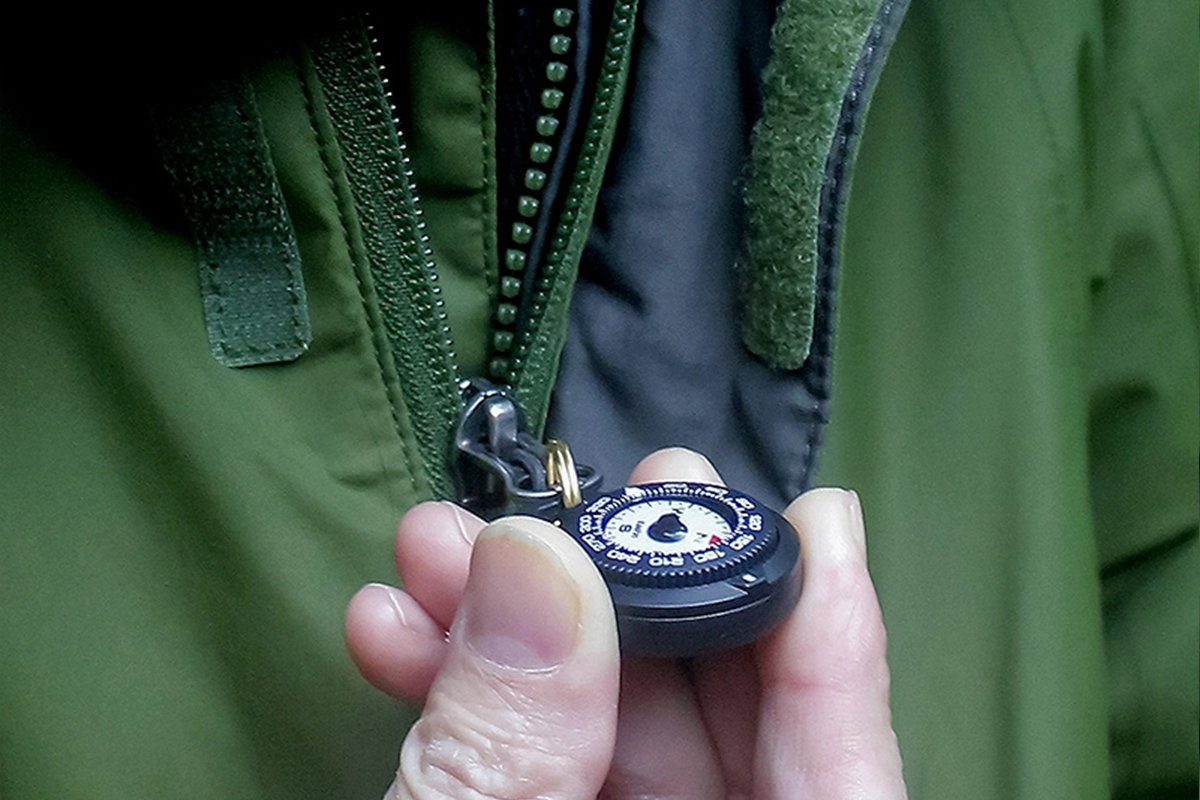
click to explore Kanpas EDC Compasses


