A simple tool that helps drivers always know where they’re heading.
Modern vehicles are equipped with advanced navigation systems, smartphone maps, and digital dashboards. Despite these technologies, many drivers still appreciate having a simple and reliable way to understand their direction on the road.
A dashboard compass provides exactly that — a quick visual reference that works quietly in the background of every drive.
It doesn’t replace modern navigation tools. Instead, it complements them by providing constant directional awareness.
Direction at a Glance
One of the most practical aspects of a driving compass is how quickly it communicates direction.
Unlike traditional handheld compasses that require interpreting a needle, a dashboard compass designed for vehicles displays the forward direction directly. When the letter “N” appears on the compass ball, it simply means the vehicle is heading north.
This direct-reading design allows drivers to understand direction instantly with just a quick glance.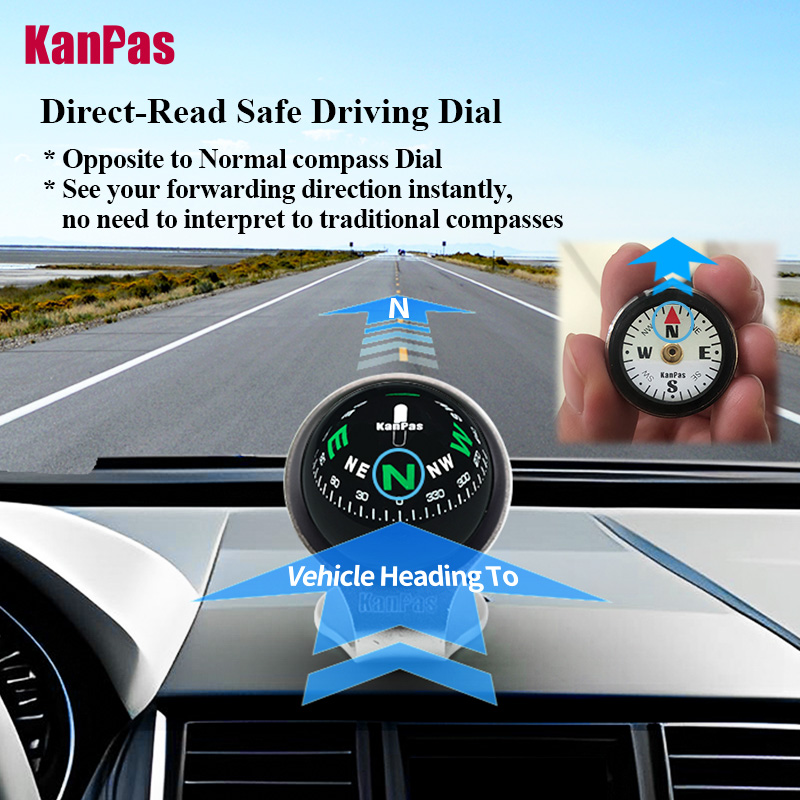
Designed to Respond to Real Driving Conditions
Driving conditions are always changing — turning corners, accelerating, slowing down, or traveling across uneven roads.
Inside the compass is a liquid-filled magnetic capsule that allows the compass ball to move smoothly and respond naturally to these changes.
During driving, the compass ball may wobble slightly. This is completely normal and allows the compass to adjust to the vehicle’s motion. Within a moment, the reading stabilizes and reflects the vehicle’s current direction.
A Durable Aluminum Holder
The compass ball is supported by a high-quality aluminum alloy holder, which provides both durability and a clean appearance on the dashboard.
Compared with plastic mounts, aluminum offers several advantages:
-
Greater durability
-
Better resistance to heat and cold
-
A refined and minimal look
-
Non-magnetic material that helps reduce interference
The raised holder design also lifts the compass slightly above the dashboard, helping maintain more stable readings.
Designed for Everyday Driving
Vehicles experience a wide range of temperatures throughout the year — from hot summer days to cold winter mornings.
A well-designed dashboard compass should be able to handle these changing conditions. At the same time, like most instruments placed on a dashboard, it is recommended to avoid leaving it under direct sunlight for extended periods.
With proper placement and care, it can remain a reliable companion for daily driving.
Clean and Simple Installation
Installing a dashboard compass is simple and requires no tools.
For the most accurate readings, the compass should be positioned away from magnetic interference, such as metal components or speakers inside the vehicle.
Once a suitable location is found, the compass can be securely mounted using the included 3M adhesive pad, creating a clean and stable installation on the dashboard.
Ideal For
A dashboard compass can be useful in many driving situations:
-
Road trips and long-distance travel
-
Mountain driving
-
Off-road exploration
-
Remote areas with limited signal
-
Everyday navigation awareness
Even with modern GPS technology, having a constant directional reference can make driving feel more intuitive and confident.
A Simple Tool That Still Matters
A dashboard compass is a small instrument, but it adds something valuable to everyday driving — a constant awareness of direction.
Whether driving through a busy city, exploring mountain roads, or traveling across unfamiliar landscapes, sometimes the simplest tools remain the most useful.
Knowing where you’re heading can make every journey feel just a little more certain.


